
Flag Meanings
What Does One Nation Under God Mean?

Apr
What Does One Nation Under God Mean?
If you want to understand “what does one nation under God mean“, the clearest place to start is the Pledge of Allegiance, but the answer goes beyond that. In this guide, Flagtify explains the phrase in plain English, shows why it was added, and explores why it still matters in history, public life, and patriotic flag design today.
The Short Answer Most People Need
If you are looking for the One Nation under God meaning, the best place to start is with the most direct reading of the words themselves. The phrase sounds simple, but its meaning changes depending on whether you read it as a religious statement, a civic tradition, or a historical part of the Pledge.

What “One Nation Under God” Means in Plain English
In plain English, “One nation under God” means one united country that acknowledges God in public civic language. The words “one nation” unite, while the words “under God” add a moral or spiritual frame.
Taken together, the phrase suggests that the country is being described not just as a political unit, but as a nation imagined under a higher authority. That is why many people hear it as both patriotic and religious at the same time.
What the Phrase Does Not Automatically Mean
The phrase does not automatically mean that the United States has an official religion. It also does not mean that every person hears the words in the same way.
Some people treat it as a genuine statement of faith. Others see it as traditional civic language that has become part of public ritual. That difference matters because it helps explain why the phrase still sparks questions about schools, law, and national identity.
What “One Nation Under God” Means in the Pledge of Allegiance
The meaning of “One nation under God” becomes clearer when you read the phrase as part of the full Pledge rather than on its own. In that setting, it connects not only to God but also to unity, shared ideals, and the broader message of the sentence.
How the phrase works in the full Pledge
The phrase appears in the middle of the Pledge: “one Nation under God, indivisible, with liberty and justice for all.” In that full sentence, the wording connects three ideas at once—unity, public belief, and the idea that the nation should remain whole. That wider context is why the phrase is usually read as more than a simple reference to God alone.
What “One Nation,” “Under God,” and “Indivisible” Mean Together
These words work best when read together.
- One Nation emphasizes unity.
- Under God introduces a public reference to God.
- Indivisible reinforces the idea that the nation is meant to remain whole.
So the meaning of the line is not only religious. It is also deeply about national unity. That is one reason the phrase keeps attracting attention: readers are often trying to decide whether the center of the line is faith or unity, when in practice it carries both.
Pledge Phrase Meaning at a Glance
| Pledge phrase | Plain meaning | Why it matters |
| One Nation | One united country | Puts unity at the center |
| Under God | A public reference to God | Adds moral and religious language |
| Indivisible | Not meant to be divided | Reinforces national wholeness |
| Liberty and justice for all | A shared civic ideal | Connects the line to rights and fairness |
Why “Under God” Was Added to the Pledge
To understand the phrase fully, it helps to know that it was not part of the Pledge from the beginning. Once you see when it was added and why, its meaning becomes much more historical than many people first assume.

From the Original Pledge to the 1942 Federal Version
One important fact is that “under God” was not part of the original 1892 Pledge. The wording most people know today developed over time, and Congress officially recognized the Pledge in federal law in 1942.
That means the phrase many people now assume was always there was actually added later. Once you know that, the wording feels less timeless and more historical.
Why Congress Added “Under God” on June 14, 1954
Congress added “under God” on June 14, 1954. This was not a minor wording change, but a formal revision that gave the Pledge a more explicit religious dimension in public civic language. That is why the date matters: it marks the moment when the phrase officially became part of the civic ritual and took on a stronger historical meaning.
How the Cold War Changed the Meaning of the Phrase
The Cold War helps explain why the change happened when it did. In the 1950s, the United States often defined itself against officially atheistic communism. Adding “under God” made the Pledge a stronger statement of national identity in that context.
Most people saying the phrase today are not thinking about Cold War politics. Still, that historical moment shaped why the words entered the Pledge and why they continue to carry more weight than a simple reference to unity alone.
What the Phrase Means Today
Even after you understand the history of the phrase, its meaning in modern life is not always straightforward. People still read it in different ways, especially when it appears in public settings like schools, ceremonies, and civic events.
The Religious Reading vs the Civic Reading
Today, the phrase is usually understood in two main ways.
The first is the religious reading, where the words are taken as a real public acknowledgment of God. The second is the civic reading, where the phrase is seen as ceremonial language that has become part of national tradition.
Both readings exist because the phrase sits inside a patriotic pledge, not a prayer, yet still includes clear religious language.
Why the Phrase Still Creates Debate
The phrase still creates debate because it appears in public settings, not private ones. Once words are spoken in schools, ceremonies, or civic events, people naturally ask whether those words represent shared values, shared faith, or something in between.
That is why the phrase remains controversial for some readers. The debate is not only about vocabulary. It is about what kind of language belongs in public civic life.
What Readers Usually Mean When They Ask About Schools and Constitutionality
When people ask whether “one nation under God” is constitutional, they usually mean something practical: whether students can be required to say it, and whether the phrase belongs in public-school recitations.
That is where legal context matters. In Barnette (1943), the Supreme Court held that students could not be forced to salute the flag or recite the Pledge. In Elk Grove Unified School District v. Newdow (2004), the Supreme Court did not strike the phrase from the Pledge. Instead, the case turned on standing, so the Court did not issue a broad merits ruling that removed “under God” from the text.
So the legal discussion is real, but short summaries often flatten the issue too much.
What Does One Nation Under God Mean on a Flag?
The one nation under god flag meaning can feel a little different once the phrase moves from the Pledge to a flag. Instead of being spoken as part of a civic ritual, it becomes a message people choose to show in a visible and personal way.
Why the Phrase Appears on Patriotic Flags
When the phrase appears on a flag, it usually signals a blend of patriotism, unity, remembrance, and public faith. That is why it fits naturally on patriotic products, memorial displays, and holiday décor. In practice, this wording tends to appeal most to buyers who want a design that feels both faith-forward and nationally symbolic, rather than purely decorative. The phrase already carries public meaning in the Pledge, so moving it onto a flag feels natural to many people who want to display country, belief, and identity together.
How the Meaning Changes When It Becomes a Visual Display
A spoken phrase and a displayed phrase do not feel the same. In the Pledge, the words are part of a shared recitation. On a flag, they become a message someone chooses to show.
That changes the tone. The phrase becomes more personal and more visual. It can feel declarative, commemorative, or faith-forward depending on the setting and the design around it.
Common Use Cases: Porch Flags, Memorial Displays, Church Events, and July 4th
In practice, the phrase works best in settings where people want patriotic meaning with emotional weight. Common examples include:
- porch flags
- memorial displays
- church events
- veterans tributes
- July 4th décor
For product use, buyers often look at common retail details such as 3×5 ft for larger display flags or 12×18 in for garden-style flags, along with features like grommets, double-sided printing, and weather-resistant fabric. Those specs do not change the meaning of the phrase, but they do matter when the phrase moves from an idea into a real display product.
Common Questions About One Nation Under God
By this point, the main meaning of the phrase is clearer, but a few practical questions still come up again and again. These are the ones readers most often ask when they want a quicker and more direct answer.
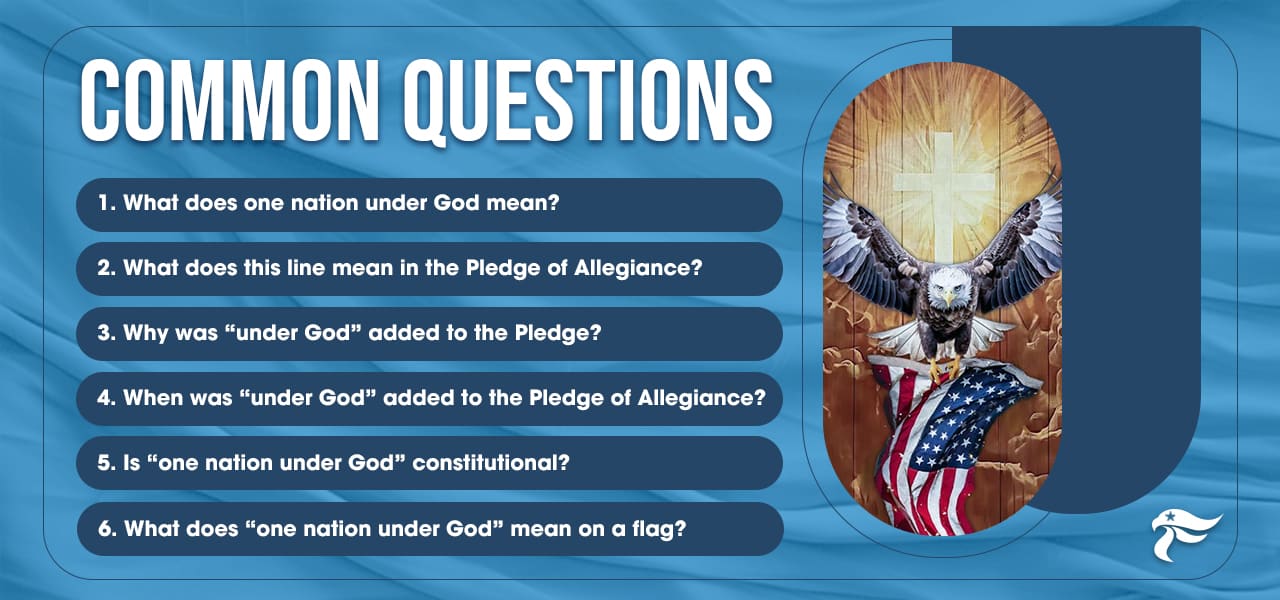
What does one nation under God mean?
The clearest place to start is the Pledge of Allegiance, but the phrase means more than one thing depending on the context. In plain English, it points to a united country described with a public reference to God. This guide explains the phrase simply, shows why it was added, and explores why it still matters in history, public life, and patriotic flag design.
What does this line mean in the Pledge of Allegiance?
In the Pledge, the phrase connects the idea of national unity with a moral or spiritual dimension.
Why was “under God” added to the Pledge?
It was added in 1954, largely to reflect Cold War-era ideas about American identity and belief.
When was “under God” added to the Pledge of Allegiance?
It was added on June 14, 1954.
Is “One Nation under God” constitutional?
The phrase has been challenged in court, but students cannot be forced to recite the Pledge, and the wording itself was not simply removed by later cases.
What does “One Nation under God” mean on a flag?
On a flag, it usually works as a visible expression of patriotism, unity, and public faith.
So, what does one nation under God mean? At its core, it expresses a vision of the United States shaped by unity, public belief, and shared civic identity. Its meaning becomes fuller when you place it in the Pledge, in its 1954 historical context, and in the way people still interpret or display it today. For readers who want to carry that meaning into a visible patriotic setting, Flagtify offers phrase-based flag designs suited to remembrance, celebration, and everyday display.
