
Faith & Identity
Types of Flag Shapes and When to Use Each

May
If your flag twists around the pole, snaps hard in the wind, or looks awkward on a bracket, the problem is often the flag format rather than the artwork. This guide explains the main types of flag shapes, what each one is used for, and how to choose the right option for your mounting setup, location, and display goals. Reviewed for mounting compatibility, readability, and common durability issues across porch, pole, event, and marine-style flag setups.
Types of Flag Shapes List
If you are not sure what shape you are looking at, start here. This section gives you a quick visual-style reference so you can identify the most common flag formats and see where each one usually works best.

Flag Shape Names and How to Recognize Them
Below is a quick reference list. Think of it as a “spot it in the wild” guide you can use in seconds.
| Flag shape | Look | Mount | Best for |
| Rectangular | Wide rectangle | Grommets/sleeve | Poles, walls |
| Square | Equal sides | Grommets/sleeve | Indoor, crests |
| Pennant | Triangle/taper | Sleeve/tabs | Sports spirit |
| Swallowtail | Forked end | Sleeve/grommets | Windy spots |
| Vertical banner | Tall rectangle | Sleeve/pocket | Porches, streets |
| Feather | Tall curved edge | Pole + base | Events, entrances |
| Teardrop | Teardrop outline | Pole + base | Events, wayfinding |
| Burgee | Boat triangle | Hoisted | Boats, clubs |
| Ensign | Boat rectangle | Hoisted | Boat ID |
| Gonfalon | Vertical w/ crossbar | Crossbar hang | Ceremonial |
| Guidon | Pointed/notched | Hoisted/held | Unit markers |
| Streamer | Long narrow strip | Pole/line | Directional decor |
Shape, Format, and Ratio: What’s the Difference?
People often group all of these, but they are not the same thing.
A flag shape is the visible outline, such as rectangular, square, pennant, or swallowtail.
A display format is the overall presentation system, such as a vertical banner, feather flag, or teardrop setup. Aspect ratio refers to the proportion, such as 2:3 or 1:2.
Getting these three things right at the same time prevents the most common buying and design mistakes.
Common Sizes and Aspect Ratios
Using the right size and aspect ratio prevents the most common disappointment: Artwork that looks stretched or cramped.
Common sizes people actually buy:
- Standard outdoor flag: 3×5 ft
- Smaller pole or portable: 2×3 ft
- House flag: 28×40 in
- Garden flag: 12×18 in
Common aspect ratios:
- Many flags use 2:3 or 1:2.
- The U.S. flag ratio is 10:19, which matters if you are printing accurate replicas or designing around official proportions.
If you are designing artwork for a specific product, design to that exact ratio first. Then adapt the layout to other ratios instead of “stretching” the file. If you are comparing products for a specific setup, it also helps to review the flag ratio, mounting hardware, and outdoor fabric construction together rather than treating them as separate decisions.
How to Choose the Right Flag Shape
If you are using a standard outdoor pole, start with a rectangular flag. If you are decorating a porch bracket, a vertical banner is usually easier to read and less likely to bunch up. If the area is breezy and your current flag snaps or wraps too often, a swallowtail shape or a smaller size may work better. For entrances, events, and sponsor areas, feather and teardrop systems usually deliver the best visibility.

Match the Shape to the Display Location
Use-case is the fastest filter.
- Home porch or front entry: Vertical banner or standard rectangle, depending on your bracket.
- Outdoor pole: Rectangular is the simplest and most universal.
- Indoor wall: Rectangle, square, or pennant, depending on your space.
- Events and tournaments: Feather or teardrop for visibility and wayfinding.
- Boat: Burgee or ensign, based on what you are signaling and where it is flown.
Match the Shape to the Mounting Hardware
Most shape mistakes happen here.
- Grommets are best when the flag will clip to a pole, halyard, or hooks.
- Sleeves and pole pockets are best for vertical banners and any setup where the flag slides onto a rod or crossbar.
- Event systems use a dedicated pole + base and a fitted fabric “skin,” so you choose the system first, then the shape.
In practical setups, the most common mismatch is simple: buyers choose artwork first and hardware second. That usually leads to crooked hanging, poor readability, or a flag that looks smaller than expected once it is mounted. In most cases, picking the mounting style first solves the problem faster than changing the design.
Do not buy a vertical banner expecting it to work like a grommet flag unless it clearly supports that hardware. Mounting mismatch is the number one cause of flags looking crooked.
Consider Wind, Sun, and Moisture
Wind is not just about strength. It is also about how your location funnels gusts.
- Windy porches and balconies often do better with smaller sizes and shapes that reduce broad flapping, such as swallowtails.
- High sun exposure increases fading and heat stress, so choose outdoor fabrics and reinforced construction.
- Rain and humidity demand one habit: never store a flag even slightly damp.
If your flag snaps loudly or wraps around the pole frequently, downsize by one step, improve the swivel hardware, or switch to a shape that performs better in your wind pattern.
Once you know the mounting style, the viewing distance, and the wind pattern, the right shape usually becomes much easier to narrow down.
Common Flag Shapes Explained
Rectangles, squares, and pennants cover most everyday displays, but they behave differently once you hang them. Here’s how to pick the right one and avoid the common proportion and sizing traps.
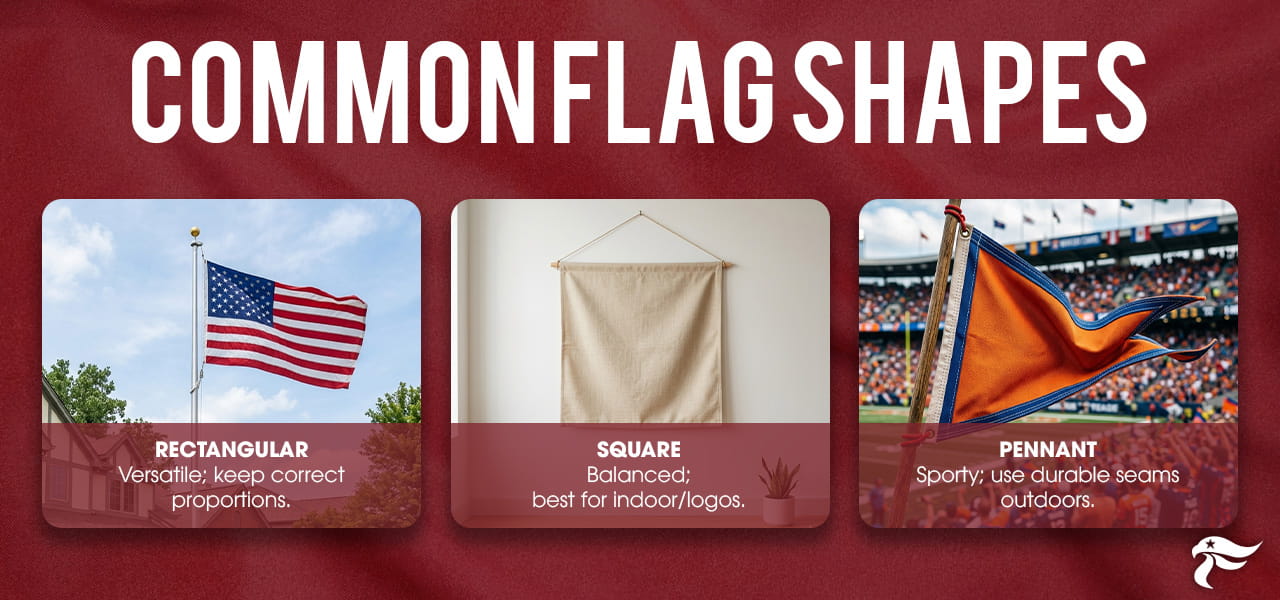
Rectangular Flags
Rectangular flags are the most universal format because they work with nearly every mounting style, from pole grommets to bracket sleeves. They are best for flagpoles, team flags, home displays, and everyday outdoor use where maximum compatibility is required. The most common issue is using incorrect design proportions.
Artwork designed for a 1:2 layout may appear cramped on a 2:3 flag, so the fix is to redesign the layout for the target ratio rather than stretching it.
Square Flags
Square flags are less common outdoors, but they are excellent when the design needs a centered, balanced look. They work especially well for crests, badges, and emblem-style graphics, and they also look intentional indoors where a square frame matches the space. A common mistake is expecting a square flag to “fill” the visual space on a long-pole setup the way a rectangle does.
On a tall pole or a wide bracket, square flags can appear smaller than expected unless you size them up or choose a different format.
Pennant Flags
Pennants are closely tied to sports and school spirit because their triangular or tapered shape signals energy and direction. They are best for indoor décor, pep rallies, team collections, and display areas where you want a more dynamic silhouette than a rectangle.
Felt is a classic indoor material, but for outdoor use, choose a durable outdoor fabric with strong seams, since the pointed end takes more stress in the wind and is often the first place to fray if the construction is weak.
Go with a rectangle for maximum compatibility, choose a square when your design needs a balanced center, and pick a pennant for a sporty, directional look. If it’s going outdoors, prioritize stronger seams where wind stress hits first.
When Vertical and Specialty Formats Work Better
A standard rectangle is not always the best-looking option once it is mounted. If the flag keeps wrapping around the bracket, looks cramped, or becomes hard to read from the street, a vertical or specialty format often performs better.
Vertical Banner Flags
Vertical banner flags are designed to hang neatly on a porch bracket, so the design remains legible from the sidewalk rather than bunching or wrapping as a loose rectangle can. This format works best for porches, front doors, street pole installations, and venue banners where vertical legibility is critical. A practical standard many people use is the house flag size 28×40 in, designed to fit common porch-style brackets and keep the artwork centered and visible.
Swallowtail Flags
Swallowtail flags use a forked cut at the fly end to reduce the hard “slap” you get from a full rectangle in gusty conditions. They are best for breezy walkways, balconies, and decorative displays where constant motion is normal and you want the flag to look smoother in the wind. The key quality detail is reinforcement: the tail area and the inner corners of the cut should be well stitched so the swallowtail shape does not become the first seam to fail.
When These Shapes Work Better Than Rectangles
These shapes outperform rectangles when your main goal is clean readability while hanging vertically, better wind performance due to less broad-surface flapping, or a more decorative silhouette for an entryway display. If your current rectangle keeps wrapping around the pole, looks awkward on a bracket, or is hard to read from the street, switching to a vertical banner or swallowtail is often the simplest fix.
In most home setups, choose a vertical banner for cleaner readability and a swallowtail format when movement and wind are the bigger concern.
Event Flags and Boat Flags
Some flag formats are highly specialized. Event styles focus on height, visibility, and portability, while marine formats are shaped by tradition, signaling needs, and local convention. Choosing the right one depends less on appearance alone and more on how and where the flag will be used.

Feather Flags and Teardrop Flags
Feather and teardrop formats are built for visibility at entrances, sponsor lanes, and fan zones. Feather flags feel taller and more directional, while teardrop flags keep a cleaner outline because the leading edge stays taut.
Burgee Flags and Ensign Flags
Burgees and ensigns are classic boating formats used for identity and tradition. A burgee is typically a triangular pennant linked to a club or boating community, while an ensign is commonly the primary identifier flown on board. Because practices vary by region, it’s best to follow local convention and marina guidelines.
Where Each Works Best
Use feather or teardrop systems when visibility and portability matter most, and reserve burgees or ensigns for marine use where local convention applies. For most home displays, rectangles and vertical banners remain the more practical choice.
Best Materials for Each Flag Shape
Material and build quality matter as much as shape because wind stress hits certain seams first. A quick fabric check and a few construction details can tell you whether a flag will hold up outdoors or wear out fast.
Nylon Flags and Polyester Flags
Choose material based on how you’ll use the flag, not just the label. Nylon is lightweight and flies easily for classic outdoor movement, while polyester is often heavier and more structured in some conditions. Since performance varies by weave and construction, judges build quality instead of assuming polyester is always stronger.
Stitching and Reinforcement That Matters
Shape affects stress points. In outdoor use, the first failure point is rarely the center of the flag. It is usually the header, the corners, the sleeve seam, or the cut end on pointed formats. That is where wind load and repeated motion tend to show up first, which is why construction quality matters more than broad fabric claims on the label.
Look for these durability signals:
- Reinforced header and corners
- Strong stitching on hems
- Quality grommets if you are using grommet mounting
- Clean sleeve seams for vertical banners
- Secure edge finishing on swallowtails and pennant tips
Cheap stitching fails first at corners and along the header. That is where the wind load concentrates.
Durability is decided less by the fabric label and more by construction. Reinforced headers, clean hems, secure grommets or sleeves, and strong finishing at tips and tail cuts are the details that usually hold up when wind load concentrates. Before buying, check the header, the corner stitching, the sleeve seam, and any pointed or cut finish first. Those are usually the areas that reveal build quality fastest in real outdoor use.
Common Questions Before You Choose a Flag Shape
These quick answers cover the questions people ask most often after learning about types of flag shapes, so you can confirm the “standard” choice, understand key differences, and pick a shape that behaves better in wind.

Is a feather flag a true shape or a display system?
Feather flags are often described as a shape, but in practice, they are part of a full display system that includes a fitted pole structure and base.
What flag shape works best for porch brackets?
Vertical banners usually work best on porch-style brackets because they hang cleaner and keep artwork readable from the sidewalk.
Which flag shape is easiest for beginners?
A rectangular flag is the easiest starting point because it works with the widest range of poles, hooks, and general outdoor setups.
What is the biggest mistake people make when choosing a flag shape?
The most common mistake is choosing the artwork first and the hardware second. That often leads to poor fit, crooked hanging, or disappointing readability.
Are shape and ratio the same thing?
No. Shape is the visible outline, while ratio is the proportion of height to width.
If you want the safest default, start with a rectangular flag. Move to a vertical banner or swallowtail only when your mounting setup or wind exposure clearly calls for it.
Choosing the right type of flag shapes is less about style alone and more about how the flag will actually be mounted, read, and exposed to movement. When the format matches the hardware, location, and wind pattern, the display usually looks cleaner, stays more readable, and wears better over time. At Flagtify, the most reliable way to narrow the choice is to start with the setup first, then fine-tune the size, material, and finish.
